How to Find the North Star
Polaris, the North Star, is the one star in the northern sky that barely moves, which makes it a reliable pointer to true north. This guide shows you how to pick it out on a clear night, and how to turn it into a direction.
Steps
Stop looking for the brightest star
Polaris is not the brightest star in the night sky, whatever you may have heard. It is only moderately bright, what astronomers call a second-magnitude star, ranked somewhere around the 47th to 50th brightest. So do not scan the sky for the brightest point of light.
Look for the star that stays still
What sets Polaris apart is its position, not its brightness. It sits almost directly above Earth's north pole, on the axis the planet spins around, less than about one degree from the north celestial pole. So it looks nearly fixed while every other star wheels around it, which is the swirl you see in long-exposure star-trail photographs.
Check you are far enough north
That fixed position also decides who can see it. Polaris is visible only from the Northern Hemisphere. It drops below the horizon at the equator and anywhere south of it, and it is very hard to see within about 10 degrees of the equator.
- Why this trick stops working near the equator: Polaris is useful because it marks the point the sky turns around, and that point sits low in the sky the further south you go. At the equator it is on the horizon itself. Travellers in the Southern Hemisphere have no equivalent star sitting over the south pole, so the north is the only pole with a marker this convenient.
Follow the two pointer stars
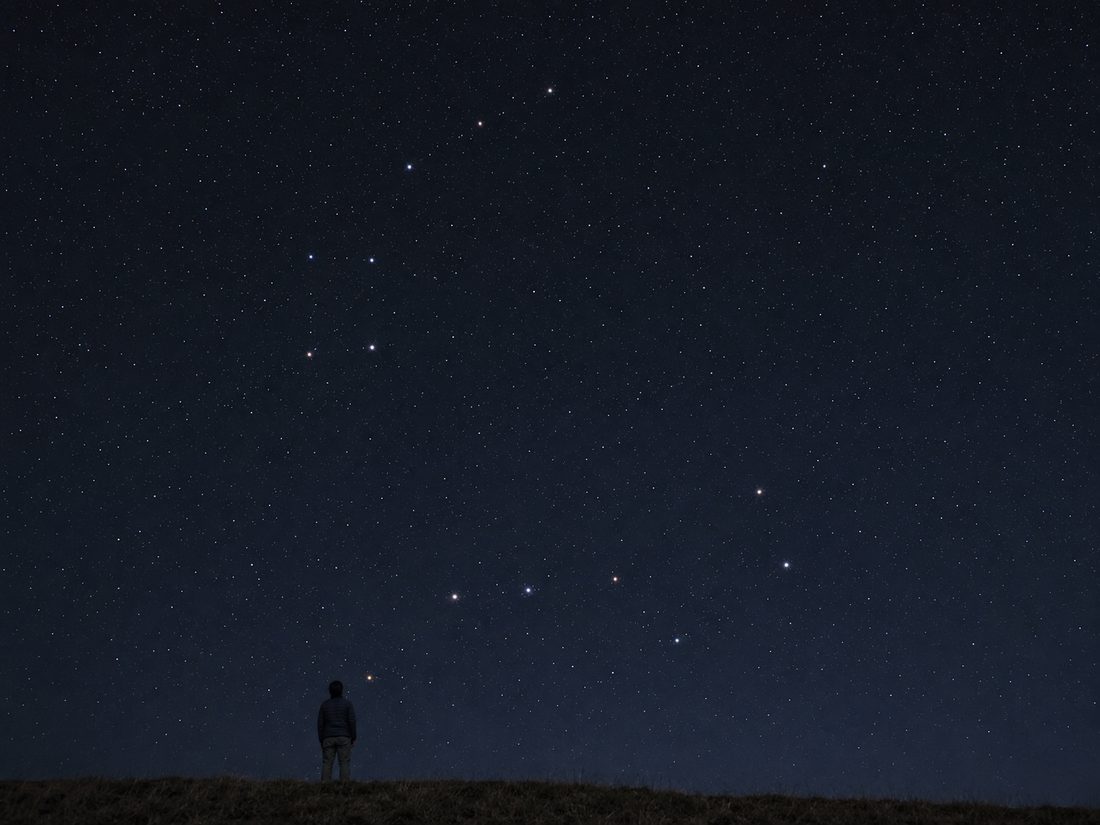
The standard method starts with the Big Dipper, part of the constellation Ursa Major. Draw an imaginary line through the two outer stars of its bowl, called the pointer stars, Dubhe and Merak. Follow that line away from the handle and it lands on Polaris, the North Star.
- Why the pointers beat the Little Dipper: the two stars of the Big Dipper's bowl are bright enough to cut through a fair amount of haze and town glow. The Little Dipper's stars are not. On a night when only the brightest stars are showing, the pointer line is often the only method that still works.
Or trace the Little Dipper's handle
There is a second route to the same star. Polaris is the last star at the end of the handle of the Little Dipper, the constellation Ursa Minor. So if you can pick out the Little Dipper directly, you have found the North Star. Its stars are faint, though, and hard to see under city lights or moonlight.
- What "true north" means here: this is the real north, the direction of the pole the Earth turns around, and Polaris sits almost on top of it. That is a different thing from what a compass needle shows, and it is why a fixed star is worth learning at all.
Turn the star into a direction
Face Polaris and you are facing true north. South is behind you, your right hand points east, and your left hand points west.
Tips
- Learn the pointer stars rather than the North Star itself. Dubhe and Merak in the Big Dipper's bowl always aim at Polaris, so the line does the work for you and you never have to judge which star is brightest.
- A bright moon costs you the Little Dipper. Its stars are faint, so on a moonlit night, or from inside a town, plan on the Big Dipper route instead.
- If you are heading south on a trip, expect to lose this method entirely. Polaris sinks out of sight at the equator and stays below the horizon south of it.
Sources
Each step in this guide is drawn from facts stated by several of these pages independently. Sources that did not corroborate anything used here are not listed.
- The North Star | Polaris Facts, Location, and How to Find It astrobackyard.com
- How to Find the North Star: A Practical Guide to Polaris, the Little ... sentinelmission.org
- Polaris: How to find the North Star | Space space.com
- How to Find the North Star in Less Than One Minute - Ask a askaprepper.com
- How To Find The ‘North Star’ With Your Naked Eyes forbes.com
- What is the North Star and How Do You Find It? - Science@NASA science.nasa.gov
Leave a comment
Comments are reviewed before appearing. See our Privacy Policy for how your name and message are handled.
Comments
No comments yet.