How to Tie a Chain Sinnet
The chain sinnet is a quick way to gather a long rope or cable into a short, tidy chain that will not tangle. It takes seconds to make, and one pull takes it all out again.
Steps

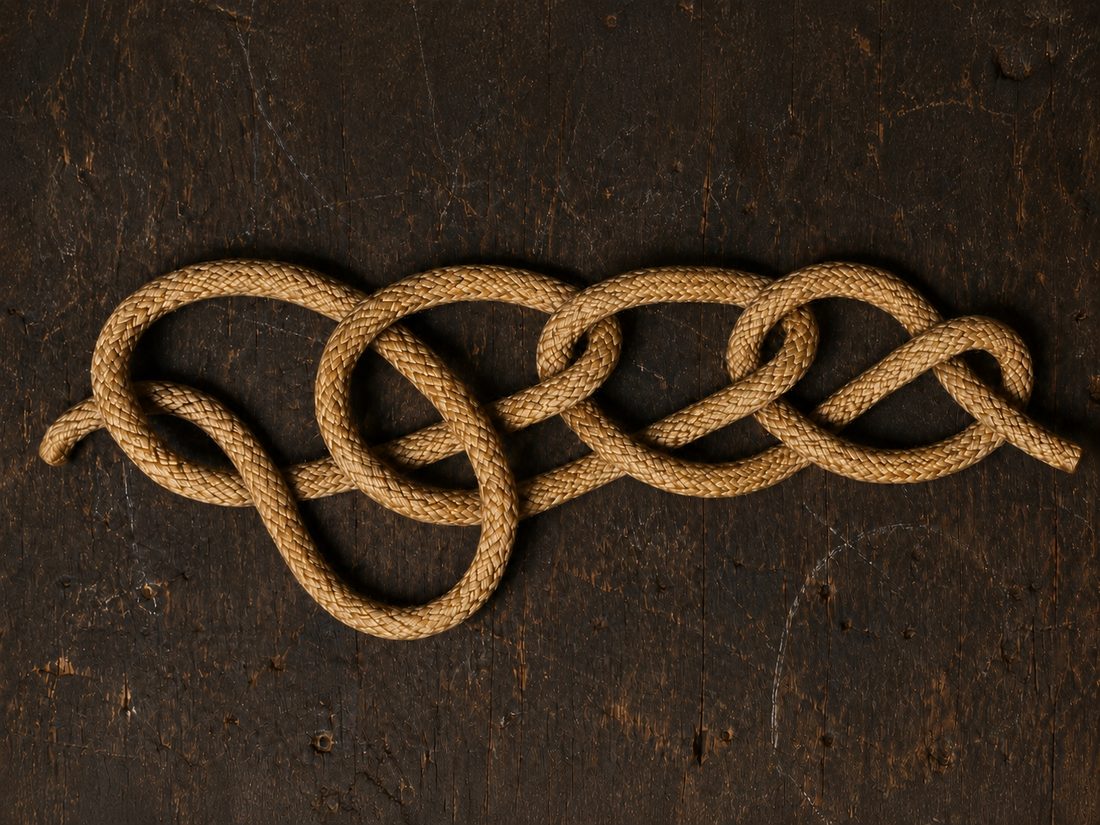
The whole chain, once through. Each link holds a fold of rope pulled through the link before it. Shorten a rope with stitches
The chain sinnet shortens a rope or cable for storage. You make it by working a series of simple stitches into the line, much the way crochet works.
Know its many names
In The Ashley Book of Knots it is knot number 2868, and it also appears as numbers 1144 and 1145. You may meet it called chain stitch, crochet stitch, daisy chain, monkey braid, monkey chain, single trumpet cord or single bugle cord.
- One knot, a heap of names: daisy chain, monkey braid and single bugle cord all describe this same chain of stitches. A video or a book using one of those names is not showing you a different knot. The names come from different trades that each found the same structure useful.
Expect an easy first knot
Behind that long list of names sits a knot that asks for very little skill or dexterity. It is often taught to children as a fun way into rope work.
Pick a slick, flexible rope
How easily it comes undone depends on the rope. Synthetic kernmantle ropes and paracord are slick and flexible, so the quick release works best in them. Kernmantle means a rope with a woven outer cover around an inner core. Natural fibre ropes such as manila or cotton have more friction, and the quick release is harder in them.
Double a very long rope first
For a very long rope, fold the line in half before you start. You can fold it a second time and work four strands at a time. Rope length decides this. Doubling shortens the finished chain further and speeds up the work, but the chain comes out bulkier.

Pull bight after bight through
Start by making a loop, noose or slip knot in the rope. Pull a bight of the working part through it. A bight is simply a U shaped fold in the rope. Then pull a fresh bight through the loop of each stitch before it, and keep going until the rope is short enough.

Tighten each loop as you go
With every new loop, snug up the one before it. This makes the chain much tighter and stops it working longer while it sits. For storage or washing you can leave the loops bigger and looser instead.
- A tight chain and a loose chain do different jobs: a tight one holds its length and stays neat while the rope is stored or carried. A loose one is faster to make and easier to shake out, which is enough when the rope is only going into a bag or a washing machine. Neither is wrong. They just suit different ends.

Lock the end, then pull to release
Finish the sinnet by passing the working end through the final loop. To release it, take that same end back out of the final loop and pull. The whole chain unravels.
Watch for four common mistakes
Uneven loop tension is the usual one. Cinching the first noose too tight makes the first loop hard to pass a bight through. Forgetting the final lock lets the chain unravel when something bumps it. Over-twisting is the fourth. If the rope starts to hockle, meaning it kinks into small loops against itself, let the free end hang and spin the tension out.
Tame extension cords and cables
Electricians call this the Contractor's Wrap and use it to store long extension cords. It works on headphone leads and other cables too, without the knotting that other coiling methods leave behind.
Coil a rope for storage
The same chain coils a rope for storage or carrying, and it keeps the coil from collapsing into a heap. It also stops a rope tangling while it goes through the washing machine.
Use it as decoration
The chain sinnet turns up on dress uniforms as well. You can use it decoratively to shorten the end of a light pull and give it a little bulk.
Spot the same stitch in crochet
That decorative side is no accident. The same structure is the crochet chain stitch that begins most crochet projects as a base chain. The oldest archaeological evidence of chain stitch embroidery comes from China in 1100 BC, and early sewing machines used the chain stitch until it was replaced, because it unravels so easily.
- Why it comes undone so willingly: the quick release is not a clever trick added to this knot. It is the nature of the chain stitch itself. Early sewing machines were abandoned for exactly the same reason, because a chain stitch runs out from one end when you pull it. What made the stitch a poor seam makes it an excellent way to store a rope.
Choose a crown sinnet for pure decoration
When you want decoration rather than a shortened rope, the crown sinnet is the other choice. It is numbers 2912 and 2915 in the same book, and it is made from a run of crown knots on three or four strands. Pick it when you want a symmetrical solid braid for a lanyard or bracelet.
Tips
- Choose your rope with the release in mind. Paracord and synthetic kernmantle rope are slick, so the chain drops apart the moment you pull. A manila or cotton rope grips itself and fights you a little on the way out.
- The same chain is worth using on things that are not rope at all. Long extension cords and headphone cables store far better this way than in a plain coil.
- If what you actually want is a braid to look at, make a crown sinnet instead. It gives a symmetrical solid braid for a lanyard or bracelet, which is a different job from shortening a working rope.
Sources
Each step in this guide is drawn from facts stated by several of these pages independently. Sources that did not corroborate anything used here are not listed.
- Chain Sinnet animatedknots.com
- Illustrated Guide: How to Tie the Chain Sinnet Knot theknotsmanual.com
- How to Tie the Chain Sinnet Knot (5+ Practical Applications) knotspedia.com
- How to Tie the Daisy Chain Knot - thebearessentials.com thebearessentials.com
- How to Tie a Chain Sinnet: The Expert Guide to Rope Storage knots.tulihost.com
- Chain Sinnet | How to tie knots3d.com
Leave a comment
Comments are reviewed before appearing. See our Privacy Policy for how your name and message are handled.
Comments
No comments yet.